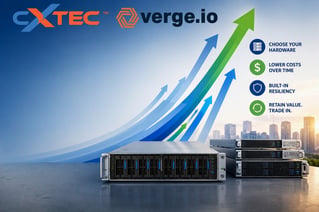
Buying hyperconverged infrastructure from a vendor that also sells the servers looks efficient on the first call. One design, one...
Buying hyperconverged infrastructure from a vendor that also sells the servers looks efficient on the first call. One design, one support contract, one number to dial. The tradeoff is the hardware decision itself and handing it over creates two problems that last the life of the cluster.
The first problem shows up in the purchase price. A vendor-supplied node costs what the vendor sets, and the buyer has one place to shop. The second shows up every year after that. Capacity grows on the vendor’s schedule, replacement parts come through the vendor’s channel, and retired equipment leaves at whatever value that ecosystem assigns.
The Compatibility List Is a Purchase Order
Nutanix and Scale Computing sell their own systems or restrict buyers to a narrow hardware compatibility list. The document reads like engineering guidance. It works as a purchase order. Once the hypervisor names the acceptable servers, sourcing options collapse to what that list allows.
Our customers see this at the second purchase rather than the first. The initial cluster gets competitive attention from every vendor in the deal. The expansion node three years later arrives at near-list price, from one source, on someone else’s lead time.
VergeOS Hands the Hardware Decision Back
VergeOS takes the opposite position, and the architecture is what makes it hold. The platform combines compute, storage, and networking in a single code base, which removes the separate SAN and fabric from the design. It installs on standard x86 servers the customer selects, including hosts already in the rack. VergeIO and CXTEC® engineers size each design against target capacity and the existing VM inventory. Licensing runs per host, so a dense server prices once instead of by core count.
Standard x86 includes our equal2new® inventory, which puts engineer-built systems back in play for a decision that once excluded them. We build to the specification the workload needs rather than the one an appliance vendor packages.
That last point matters at renewal time. A per-core model rewards the vendor every time you add sockets. Per-host licensing rewards you for buying denser servers, and denser servers reduce node count, which frees hardware for trade-in.
Software Resiliency Makes Hardware Choice Practical
Hardware freedom raises a fair question. If the buyer picks the servers, what protects the workload when one of them fails? VergeOS answers in software, across four layers that operate underneath whatever hardware you install.
Drive redundancy and immutable snapshots protect the data first. Redundancy absorbs the loss of a drive, and immutable snapshots hold recoverable copies locked against ransomware and operator error. Real-time live migration handles the server layer, moving running VMs off a node the moment it shows signs of failure.
ioGuardian goes further, keeping volumes online through multiple simultaneous drive or server failures, the combinations that stop conventional RAID and standard HCI. Integrated replication and virtual data centers restart a complete environment at a second site after a wide-area outage.
Those four layers operate underneath every equal2new server we ship. Our half of the answer is hardware. Every equal2new system is engineer-built and burned in at ISO 9001-certified facilities. A configured server ships with a lifetime warranty on the chassis and every component with memory included, and RapidCare® delivers 8x5 next-business-day or 24x7 four-hour parts replacement at about one third the cost of a comparable OEM contract. Software resiliency and hardware coverage address the same risk from two directions.
What Saratoga Casino Holdings Chose
Scott Bartgis runs IT for four casino properties, and he started with a stack he never picked. A former business partner standardized the environment on Cisco UCS blades, mirrored Pure Storage arrays, and VMware. When that partnership wound down, the operating cost returned to his team, including roughly $50,000 a year in array maintenance. VergeIO covers the economics of replacing a mirrored all-flash pair in its guide to picking a Pure Storage alternative.
He looked at the small footprint hyperconverged platforms first, and they fell short at his largest site on nodes, capacity, RAM, and performance. Nutanix priced close enough to VMware that he grouped the two together on cost and complexity.
Our team asked for a couple of days before he signed the renewal, then built a VergeOS design on equal2new nodes. It priced at almost half of Scale Computing, well under Nutanix, and included more compute, more RAM, and more storage capacity than either. Scott had already bought equal2new switches and servers for his other properties, so that half of the proposal arrived on familiar ground.
He keeps the same database replicated on both platforms today, one copy on VergeOS and one on the all-flash array he retired. He cannot tell them apart.
“It is no different other than my checkbook has a little more money in it.”
Scott Bartgis, Corporate Director of IT, Saratoga Casino Holdings
Growth by Node Instead of by Chassis
Hardware choice pays a second time at expansion. After a decade in service, Scott’s three-tier gear stopped accepting matching blades and SFPs, and growing the array from 10 to 20 terabytes had already proven expensive. Adding capacity to VergeOS means adding a node. He calls us, we build the equal2new node to match the cluster, and the workload spreads across the hosts rather than concentrating in one chassis.
The equipment coming out holds value too. We buy back retired servers, nodes, and arrays and apply the value as trade-in credit. Bring the inventory list and we will quote your specific gear.
Own Your Stack Again
A hypervisor that dictates your hardware makes every future purchase a single-source purchase. Software that runs on servers you select gives that decision back, and gives a hardware partner room to work on your behalf.
Scott Bartgis tells the full story in a live session on August 13.
Register for the session
Bring your renewal quote and your current inventory. We will price a VergeOS design on equal2new systems against it, and show you what your retired gear is worth.
Recent Posts
Buying hyperconverged infrastructure from a...
Ann Arbor, MI and Syracuse, NY, August 4, 2026:...
When we discuss digital transformation, we...
Posts by Tag
- Server (13)
- Switches (11)
- Maintenance (10)
- Dell Server (9)
- IT Hardware (9)
- Refurbished (9)
- Refurbished Servers (8)
- hardware (8)
- ITAD (7)
- it assets (7)
- cisco (6)
- IT Infrastructure (5)
- network (5)
- Avaya (4)
- Hardware Failures (4)
- IT (4)
- IT Equipment (4)
- Sustainability (4)
- esg (4)
- microchip shortage (4)
- storage (4)
- supply chain (4)
- Dell Equipment (3)
- E-Waste (3)
- Avaya Phones (2)
- Cabling (2)
- HP (2)
- HP switch (2)
- IP Phones (2)
- IT costs (2)
- IT procurement (2)
- Server Maintenance (2)
- cisco router (2)
- data center (2)
- decommissioning (2)
- equal2new (2)
- factory reset (2)
- lifecycle (2)
- lifecycle management (2)
- ucs (2)
- used cisco (2)
- used cisco hardware (2)
- verge.io (2)
- vmware (2)
- ACP (1)
- AP (1)
- Access Points (1)
- Aruba (1)
- Avay 9620 (1)
- Avaya 1608 (1)
- Avaya 4600 Series (1)
- Avaya 9600 Series (1)
- Avaya 9608 (1)
- Avaya DHCP (1)
- Brocade (1)
- Carbon Offsetting (1)
- Data Security (1)
- Fiber Optic Cables (1)
- Fiber Optic Cabling (1)
- Hardware Security (1)
- Hybrid (1)
- IT Contributes (1)
- IT disposal (1)
- IT infrastructures (1)
- NETWORKING (1)
- POE (1)
- ProLiant Servers (1)
- R2v3 (1)
- SLAs (1)
- Safeguard (1)
- Switch (1)
- Used Network Equipment (1)
- data centers (1)
- data destruction (1)
- data disposal (1)
- environments (1)
- health (1)
- infrastructure (1)
- strategy (1)
- urban mining (1)
Popular Posts
In the cable world, the term structured cabling...

Network switches are fundamental components of...

Switches are the “building blocks” of any modern...